

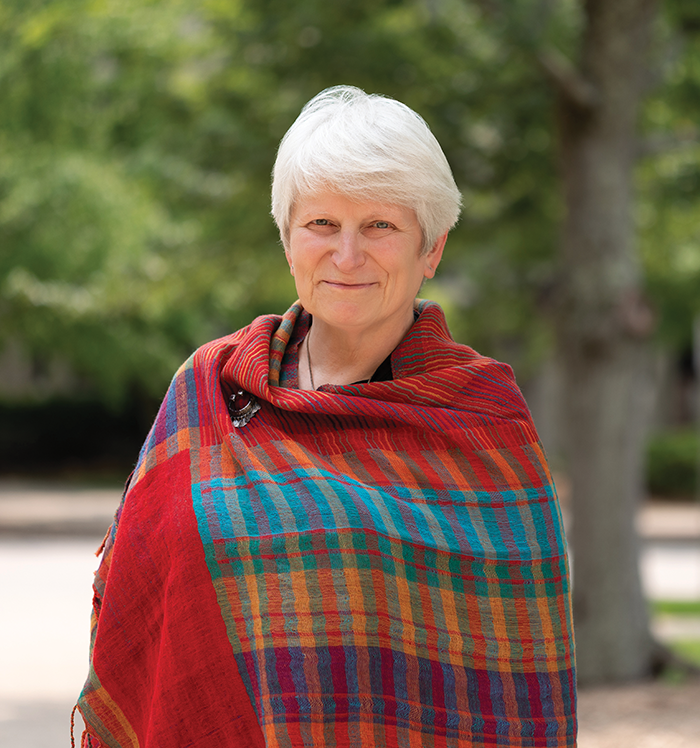
Dr. Aina Puce, Eleanor Cox Riggs Professor of Psychological and Brain Sciences at Indiana University, believes that the worlds of science and art are not just interconnected—they are inseparable. In this issue of Schema, Dr. Puce shares her connection to the Eskenazi Museum as a social neuroscientist, IU faculty member, volunteer museum guide, and photographer.
“Ever since pre-human history there have been links between science and art—both endeavors can help to explain our natural world and make us think about and question what is happening around us,” Dr. Puce reflects. “People seem to think that there is a chasm between scientists, engineers, and artists—there isn’t: scientists and artists are completely ensnared within their current projects.” Both pour themselves into their work with equal passion, face the same frustrations, and experience the same exhilaration when things finally click.
A scientist first and a lifelong photographer second, Dr. Puce has explored the artist-scientist relationship from both sides. Her photography has been exhibited in Bloomington, Indiana, at Pictura Gallery, and, more recently, at the Waldron Arts Center.
Dr. Puce’s dual identity fuels her research into how the brain processes and creates art—and why that matters for society today. As a social neuroscientist, she studies the mental states of others, including intentions for their actions and their emotional states, an ability referred to as “theory of mind.” This also includes empathy. As Dr. Puce puts it, “Empathy is an important quality—it allows us to assist those in need. As a social species, this is how we have been so successful: we need others to survive, and theory of mind paired with empathy has enabled us to do that as a species.” This ability to empathize helps us connect with others in daily life, and to understand and appreciate the arts. Dr. Puce explains, “The arts make us human. As human primates we are a social species par excellence: we are the only creature whose utterances express abstract and symbolic meanings.”
